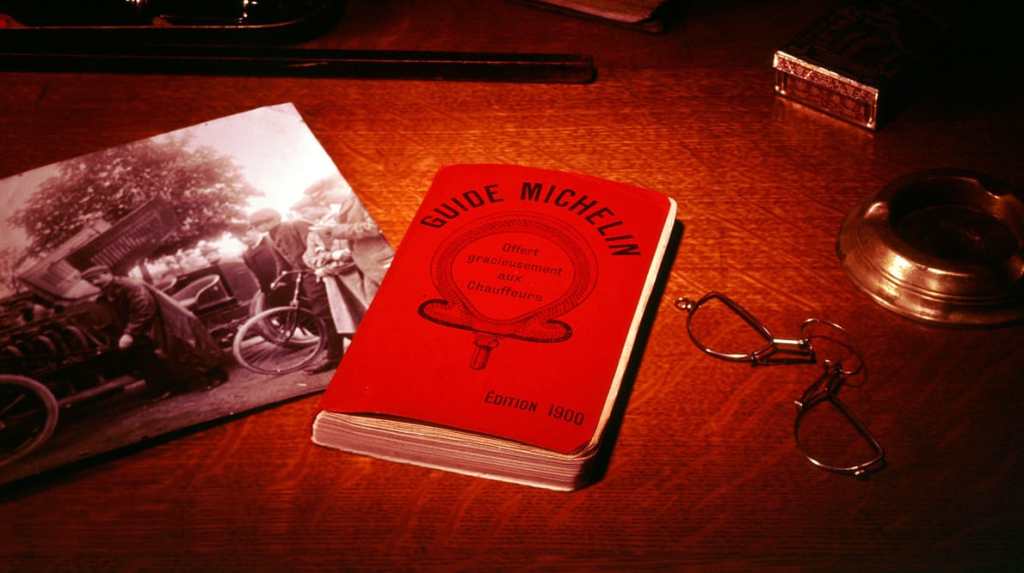
In 1900, brothers André and Édouard Michelin had a problem. They made tires. But there were fewer than 3,000 cars in all of France. No cars, meant no travelled miles. No travelled miles, meant no worn tires. No worn tires, meant no one needed what they were selling, which meant they had no business.
So they did something unusual. They stopped thinking about tires and started thinking about roads.
They published a small red guide. And here is what made it remarkable: it said nothing about tires. Not a word about rubber or tread technology. Instead, it told drivers where to find a good meal, a comfortable inn, a petrol station, a mechanic, a scenic route worth taking. It was a guide to the pleasures of going somewhere. It made the journey itself feel worthwhile.
The logic was simple and brilliant. If people had reasons to drive, they would drive. If they drove, they wore out tires. If they wore out tires, they needed new ones. The guide did not advertise the product. It created the world in which the product became necessary.
This is complementarity. You don’t just sell the thing. You build the conditions in which the thing becomes essential.
The guide grew. By 1920 it had expanded to include hotel listings, categorized restaurants, and anonymous inspectors visiting establishments to verify their quality. It became something people valued entirely for its own sake. Drivers planned journeys around it. Restaurants competed for its recognition. Today the Michelin Guide covers more than 30,000 restaurants across three continents, and more than 30 million guides have been sold. The tire company accidentally built one of the most trusted institutions in the history of food.
They were trying to sell tires. They ended up building a culture of travel.
Christian publishers have the same problem the Michelin brothers had. Not a tire problem. A reading problem.
Most people are not readers. They do not wake up wanting a theology book. They are not waiting for your next release. They are managing their lives, raising their children, surviving their jobs, and trying to make sense of their faith without a lot of help. The book you published is not on their radar. It may never be.
The standard response is to market harder. Better cover. Bigger discount. More posts. But you are still only talking to people who were already inclined to pick up a book. You are optimizing for an existing appetite rather than creating a new one.
The Michelin brothers did not find more drivers. They made more driving.
What would it look like to build the Christian publishing equivalent of the Michelin Guide? Not a catalog. Not a promotion. Something that creates the conditions in which reading becomes natural and the books you publish become the obvious next step.
It might be a pastor who recommends a book from the pulpit every month, building a congregation that expects to read together. It might be a conference that gathers isolated pastors who have never met each other, creating the kind of community that generates theological hunger. It might be a podcast that surfaces the questions your catalog is already answering. It might be a training program that develops the kind of leader who cannot do their work without the tools you publish.
None of these are marketing. They are ecosystem building. They create the roads that your books were made to travel.
Notice what the Michelin brothers did not do. They did not put a tire advertisement in the guide. They did not mention their product on the cover. They served the driver so well, so generously, so completely, that the driver’s life became organized around the very activity that made tires necessary. The guide built trust. The tires were what trust eventually sold.
The publisher who understands this stops asking how do we sell more books and starts asking how do we build a world in which more people need what we publish. Those are different questions. They produce different strategies. And they produce different results.
The Michelin Guide became more famous than the tires. The culture of travel it created outlasted any campaign the brothers could have run.
The books are already published. Who is building the roads?





Leave a comment